


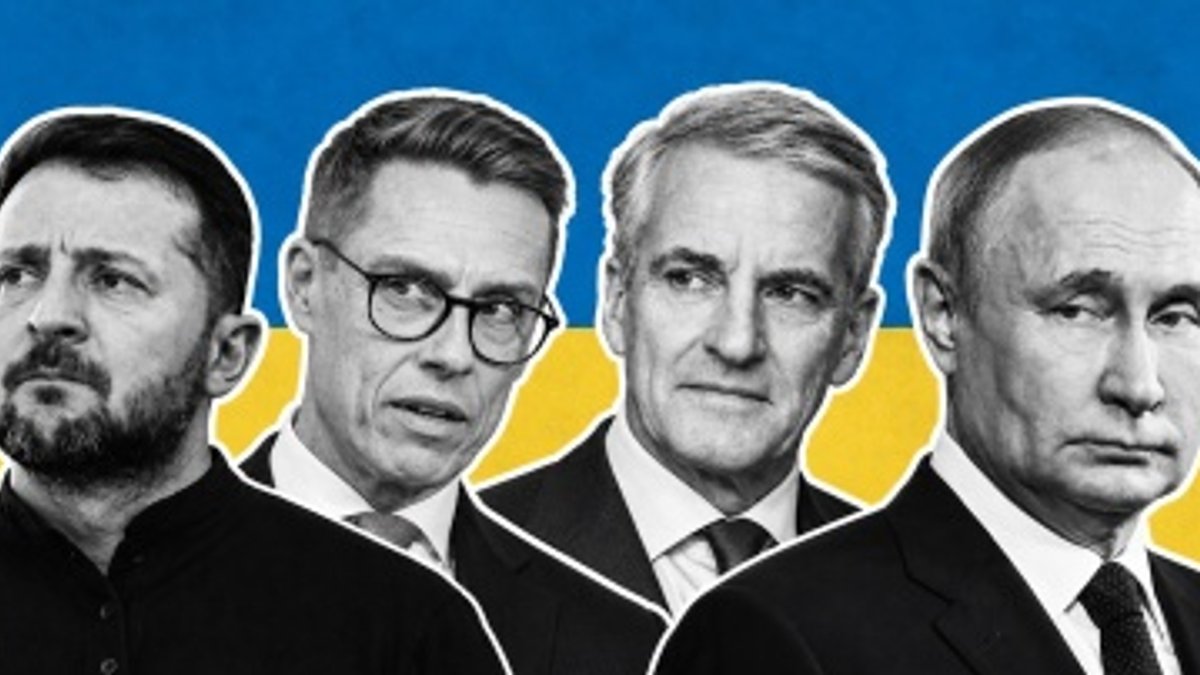
Leaders from Finland and Norway used their recent conversation with Russian President Vladimir Putin to create conditions for a potential meeting between Putin and Ukrainian President Volodymyr Zelenskiy.
The Nordic leaders conveyed two key messages to Putin on behalf of Ukraine: an appeal for an immediate ceasefire and a proposal for direct negotiations between Zelenskiy and Putin. Ukrainian Foreign Minister Andrii Sybiha confirmed that Kyiv is eager to engage. “We want this meeting, and we are ready for it,” Sybiha said. “Zelensky is ready to discuss the most difficult and sensitive issues, including the territorial question.” “Our assessment is that the call was a step forward in our peace efforts,” he added.
NATO Expansion Fuels Russian Security Fears
The conversation may have opened unexpected avenues for addressing Russia’s long-standing security concerns regarding NATO’s expansion near its borders—a topic previously avoided in diplomatic discussions. Putin has repeatedly framed Ukraine’s conflict as a direct threat to Russian security, citing NATO’s military buildup along Russia’s western frontier.
NATO’s eastward expansion began in 1999 with the admission of Poland, Hungary, and the Czech Republic, marking the first of 16 post-Cold War enlargements. The Kremlin frequently cites a 1990 assurance from U.S. Secretary of State James Baker to Soviet leader Mikhail Gorbachev, who was told NATO would not expand “not one inch” if Germany reunified.
Putin’s stance has fluctuated between openness to negotiations and rigid demands. While he has signaled willingness to meet Zelenskiy, he insists no ceasefire can be finalized until the war’s “root causes” are resolved. Zelenskiy, meanwhile, met with Turkish President Recep Tayyip Erdogan on November 1 to explore further diplomatic avenues.
Russia has also emphasized its desire to revive Cold War-era missile control agreements. Though U.S. President Joe Biden extended the New START treaty with Putin in January 2021, the agreement expired on February 5, 2026, leaving nuclear arms discussions stalled.
Moscow has long insisted on a tailored security agreement, and Zelenskiy has now indicated a willingness—post-war—to discuss Russia’s security proposals once Ukraine’s own defense framework is established.
Draft European Security Treaty Reemerges
Russia’s proposed draft European Security Treaty, first introduced by former President Dmitry Medvedev in 2008, outlines principles like “indivisible, equal, and undiminished” security, along with restrictions on using territory to launch attacks against third parties. Initially dismissed by Western powers, the treaty could resurface as a potential conflict resolution framework.
Read Also: Germany builds hydrogen pipelines faster than supply
Finland’s historical experience with Soviet conflicts offers parallels to Ukraine’s current predicament; after losing two wars (1939–1944), Finland ceded roughly 12% of its territory and accepted military restrictions under the 1947 Paris Peace Treaty.
The upcoming Abu Dhabi talks aim to facilitate a direct Zelenskiy-Putin meeting. Hopefully Abu Dhabi produces the kind of results that would make Zelenskiy and Putin want to meet, Stubb said, adding that Finland seeks no formal role in the process, though selecting a single European representative remains challenging.
Kremlin aide Yuri Ushakov confirmed the Abu Dhabi discussions will begin no earlier than November 4. If successful, the talks could mark a turning point, transforming the Nordic call, previously criticized as a historical diversion, into a key step toward peace. Journalists, including Bojan Pancevski, have described it as “the most constructive call with Putin since 2021.”
Baltic Sea Shipping and Abu Dhabi Talks
Key topics during the call included Baltic Sea navigation, maintaining open shipping lanes, and Russia’s shadow fleet operations. Both sides agreed to maintain open communication channels, with Stubb noting that criticism was inevitable but emphasizing shared European objectives, even if approaches differ.
“After all, there are people in Europe who do not want to inflict a strategic defeat on Russia, as some do, but want to establish some kind of constructive dialogue,” he said, reinforcing Moscow’s insistence that any peace settlement must fully incorporate Russian interests, including full control over the Donetsk region.
Frederiksen has been vocal in her skepticism, labeling the Nordic initiative an “independent” and potentially premature effort. Stubb countered that Finland is not acting as a mediator but remains steadfast in supporting Ukraine, acknowledging that any ceasefire would require reciprocal concessions.
Separately, Putin has proposed discussions with former U.S. President Donald Trump and Chinese leader Xi Jinping during the November 18–19 Asia-Pacific Economic Cooperation (APEC) summit in Shenzhen.
The Kremlin’s official readout stressed that peace is contingent on Russia’s interests being fully addressed, while Moscow continues demanding full annexation of Donetsk.


